
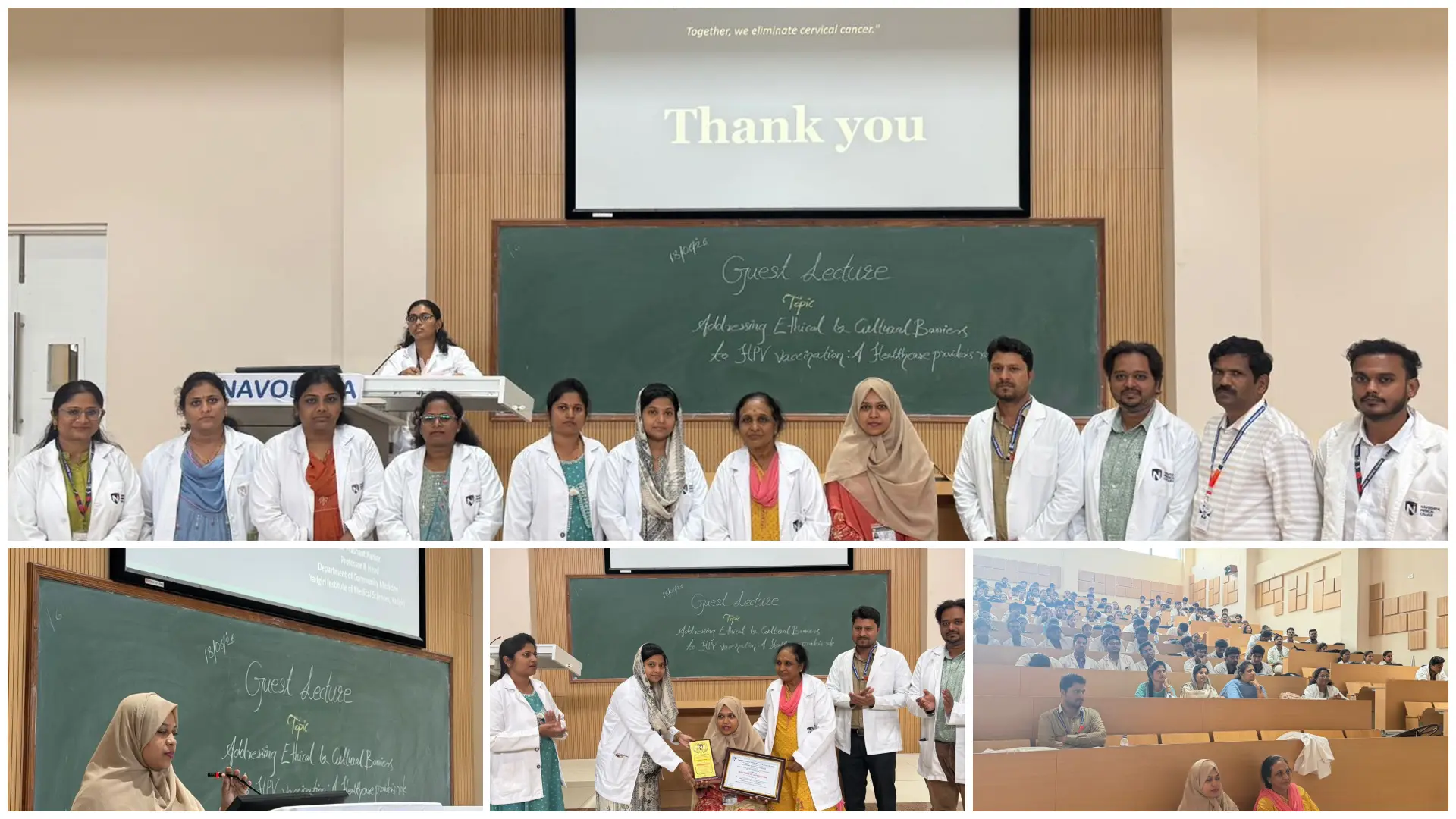

Guest Lecture on Addressing Ethical and Cultural Barriers to HPV Vaccination
The Department of Community Medicine, Navodaya Medical College, Raichur, organized an enlightening guest lecture on “Addressing Ethical and Cultural Barriers to HPV Vaccination: A Health Provider’s Role” for undergraduate students, interns, postgraduate residents, and faculty members.
The session was delivered by Dr. Bushra Jabeen, Associate Professor, Department of Community Medicine, Yadgiri Institute of Medical Sciences, Yadgiri, a distinguished public health expert with extensive experience in preventive medicine, immunization, and community health.
The lecture focused on Human Papillomavirus (HPV), one of the most common viral infections worldwide and a major cause of cervical cancer. Dr. Bushra highlighted the significant burden of cervical cancer globally and in India, emphasizing that a large proportion of cases and deaths occur in low- and middle-income countries. She explained the natural history of HPV infection, risk factors associated with persistent infection, and the progression from precancerous lesions to invasive cervical cancer.
The session underscored the importance of preventive strategies, particularly HPV vaccination and cervical cancer screening, in reducing the disease burden among women.
Dr. Bushra discussed recent developments in HPV vaccination policies, including the World Health Organization’s recommendation of a single-dose schedule for adolescents and the evidence supporting its effectiveness. She emphasized that HPV vaccination is one of the most successful cancer-prevention interventions available and has the potential to save thousands of lives by providing early protection against high-risk HPV strains.
A key highlight of the lecture was the discussion on the social, cultural, and ethical barriers that hinder vaccine acceptance. The speaker addressed misconceptions surrounding HPV vaccination, including myths related to infertility, concerns about vaccine safety, and the stigma associated with discussing sexually transmitted infections.
She explained how cultural norms, gender dynamics, religious beliefs, and misinformation can influence parental decisions regarding vaccination. The importance of framing HPV vaccination as a “cancer prevention vaccine” rather than focusing solely on its association with sexual transmission was strongly emphasized.
Dr. Bushra highlighted the responsibility of healthcare providers in promoting evidence-based decision-making while respecting cultural values and individual beliefs. Effective communication techniques, strategies to address vaccine hesitancy, and the role of healthcare workers as trusted sources of information were discussed in detail.
The speaker further elaborated on the World Health Organization’s 90-70-90 strategy for cervical cancer elimination and stressed the need for coordinated efforts involving healthcare professionals, schools, ASHA workers, Anganwadi workers, policymakers, and community leaders.
The program was presided over by Dr. Gurudatta Pawar, Principal, Navodaya Medical College, whose presence reflected the institution’s commitment to promoting public health education and preventive healthcare. Dr. Boramma G, Professor and Head, Department of Community Medicine, played a pivotal role in organizing and coordinating the event.
The session concluded with an engaging interactive discussion, during which students and faculty members actively participated by raising questions on vaccine safety, cultural barriers, implementation challenges, and public health strategies. The lecture proved to be highly informative and insightful, reinforcing the crucial role of healthcare providers in promoting HPV vaccination and advancing cervical cancer prevention efforts.