

ISA-CME PARTICIPATION AND EMERGENCY CARE TRAINING BY DEPARTMENT OF ANESTHESIOLOGY
The Department of Anesthesiology at Navodaya Medical College Hospital and Research Centre continues to uphold its longstanding commitment to academic excellence, evidence-based clinical practice, continuous medical education, and the professional development of healthcare personnel. Over the past month, the department has actively participated in a wide range of academic activities, regional conferences, workshops, and training programs aimed at strengthening clinical expertise, promoting research-oriented learning, and enhancing patient safety standards.
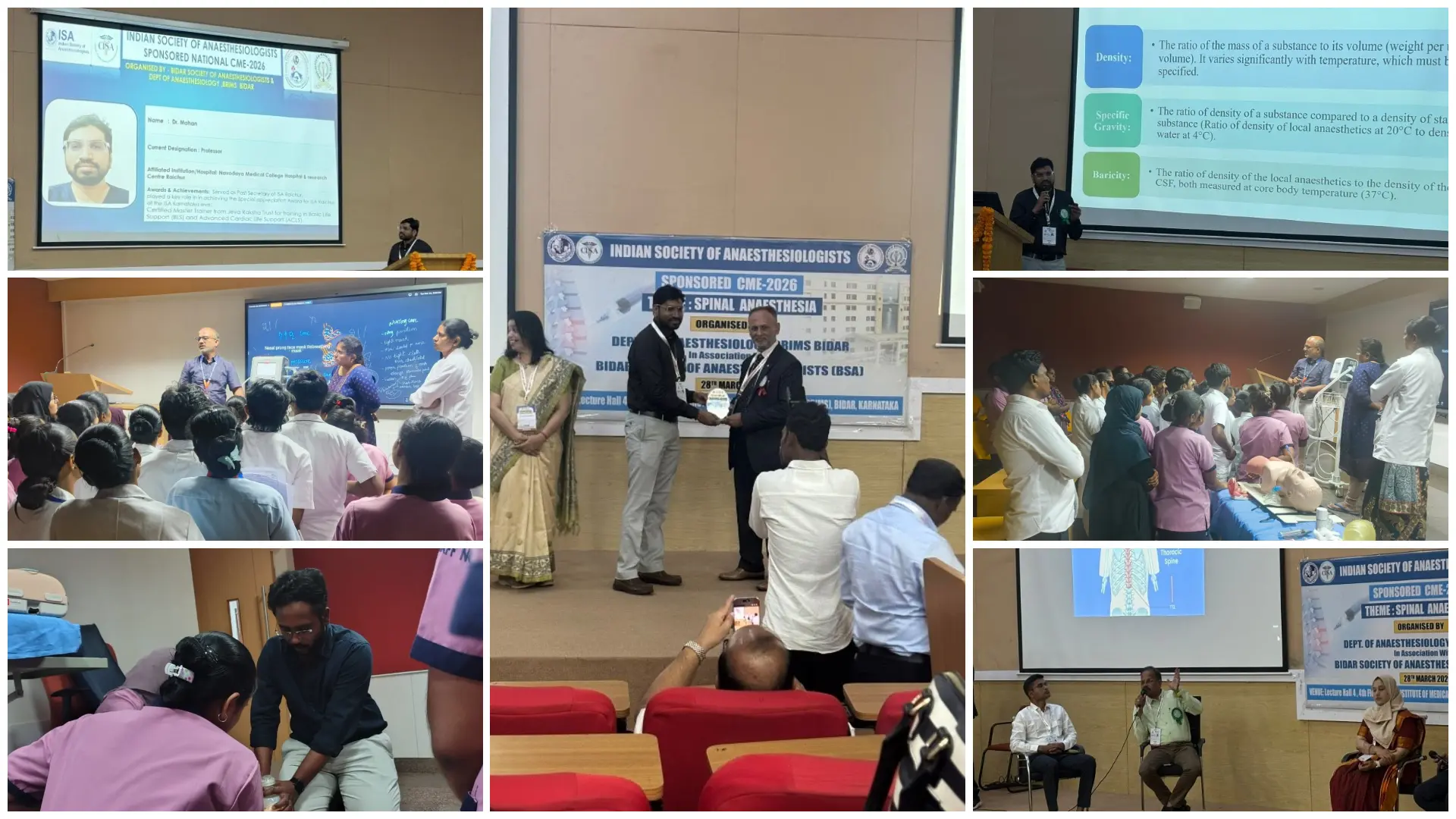
As part of its academic outreach and contribution to the advancement of anesthesiology practices, the department proudly participated in the Indian Society of Anaesthesiologists Continuing Medical Education (ISA-CME) program conducted at Bidar Institute of Medical Sciences on March 28th, 2026. The event brought together eminent anesthesiologists, postgraduate students, and healthcare professionals from across the region to discuss emerging trends, current evidence, and evolving clinical practices in anesthesiology and perioperative medicine.
Representing the department with distinction, Prof. Dr. Mohan, delivered an informative and thought-provoking guest lecture titled, “Factors Influencing the Characteristics of Spinal Anesthesia – Scope for More Rational Practice.” The lecture focused on the various physiological, pharmacological, and technical factors that influence the onset, duration, spread, and effectiveness of spinal anesthesia. Emphasis was placed on patient-specific considerations, drug selection, baricity, positioning, needle characteristics, and the importance of individualized anesthetic planning. The session generated active discussion among delegates and highlighted the need for a more rational and evidence-based approach to spinal anesthesia administration in contemporary clinical practice.
Further strengthening the department’s academic presence at the conference, Prof. Dr. Vishwanath Meti participated as an invited panelist in an engaging and clinically relevant discussion on the topic, “Safety of Spinal Anesthesia for Newer Indications.” The panel explored the expanding applications of spinal anesthesia in modern surgical practice, including its use in high-risk patients, elderly populations, minimally invasive procedures, and surgeries traditionally performed under general anesthesia. Dr. Vishwanath Meti shared valuable clinical insights drawn from practical experience and current literature, emphasizing patient safety, proper monitoring, risk stratification, and careful perioperative management. His contributions were well appreciated by participants and added significant value to the academic deliberations.
The Department of Anesthesiology at Navodaya Medical College Hospital and Research Centre remains deeply committed not only to academic advancement and clinical excellence but also to the continuous empowerment and professional development of nursing staff, who form the backbone of quality patient care. Recognizing the critical role nurses play in emergency response, perioperative management, and intensive care services, the department recently organized a series of focused internal training initiatives aimed at strengthening practical skills, improving clinical preparedness, and enhancing multidisciplinary teamwork within the hospital.
As part of these efforts, comprehensive hands-on training programs were conducted to equip nursing personnel with updated knowledge and essential life-saving competencies required in day-to-day clinical practice. These initiatives reflected the department’s vision of creating a highly skilled and responsive healthcare workforce capable of delivering safe, efficient, and patient-centered care across all clinical settings.
One of the major highlights of the training activities was the Basic Life Support (BLS) Training session conducted by Dr. Gowtham Kumar N, Assistant Professor. The session was designed to provide nursing staff with rigorous practical training in the recognition and immediate management of life-threatening emergencies such as cardiac arrest, respiratory arrest, choking, and sudden collapse. Through interactive demonstrations and simulation-based teaching, participants were trained in essential resuscitation techniques including high-quality cardiopulmonary resuscitation (CPR), chest compressions, airway management, rescue breathing, and the use of automated external defibrillators (AEDs).
The training emphasized the importance of rapid assessment, prompt intervention, and coordinated team response during medical emergencies. Nurses actively participated in hands-on skill stations, allowing them to practice critical procedures in a structured and supervised environment. The session also highlighted recent updates in resuscitation guidelines and reinforced the importance of maintaining confidence, precision, and calm decision-making during high-pressure situations. By strengthening these core emergency response skills, the department aims to improve patient survival outcomes and enhance the overall readiness of healthcare teams in emergency and critical care areas.
In another important educational initiative, Prof. Dr. Ramesh Babu, Head of Department, conducted a highly informative and practical session on the “Basics of Oxygen and Ventilator Support.” This training program focused on enhancing the understanding of respiratory care among nursing staff, particularly in the management of critically ill patients requiring oxygen therapy and mechanical ventilation. Given the increasing importance of respiratory support in intensive care and perioperative medicine, the session provided valuable insights into both theoretical concepts and practical aspects of ventilator management.
The program covered essential topics such as the principles of oxygen delivery, various oxygen administration devices, indications for oxygen therapy, monitoring of oxygen saturation, and prevention of complications associated with oxygen use. Dr. Ramesh Babu also explained the fundamentals of mechanical ventilation, including common ventilator modes, basic ventilator settings, alarm recognition, troubleshooting techniques, and nursing responsibilities in ventilated patient care. Special emphasis was placed on patient monitoring, infection prevention, airway care, and the early identification of respiratory deterioration.
The interactive nature of the session encouraged active participation and allowed nursing staff to clarify practical doubts encountered in daily clinical practice. Case-based discussions and real-life clinical examples further enriched the learning experience and helped participants understand the importance of timely intervention and coordinated teamwork in managing critically ill patients. Such focused respiratory care training plays a crucial role in improving patient safety, reducing complications, and ensuring effective management within operation theatres, intensive care units, and emergency departments.
Through regular workshops, simulation exercises, and interdisciplinary teaching programs, the department remains committed to nurturing a competent and confident healthcare workforce capable of responding effectively to the evolving demands of modern medicine. These endeavors not only contribute to professional growth among healthcare providers but also reinforce the institution’s mission of delivering compassionate, safe, and high-quality.