
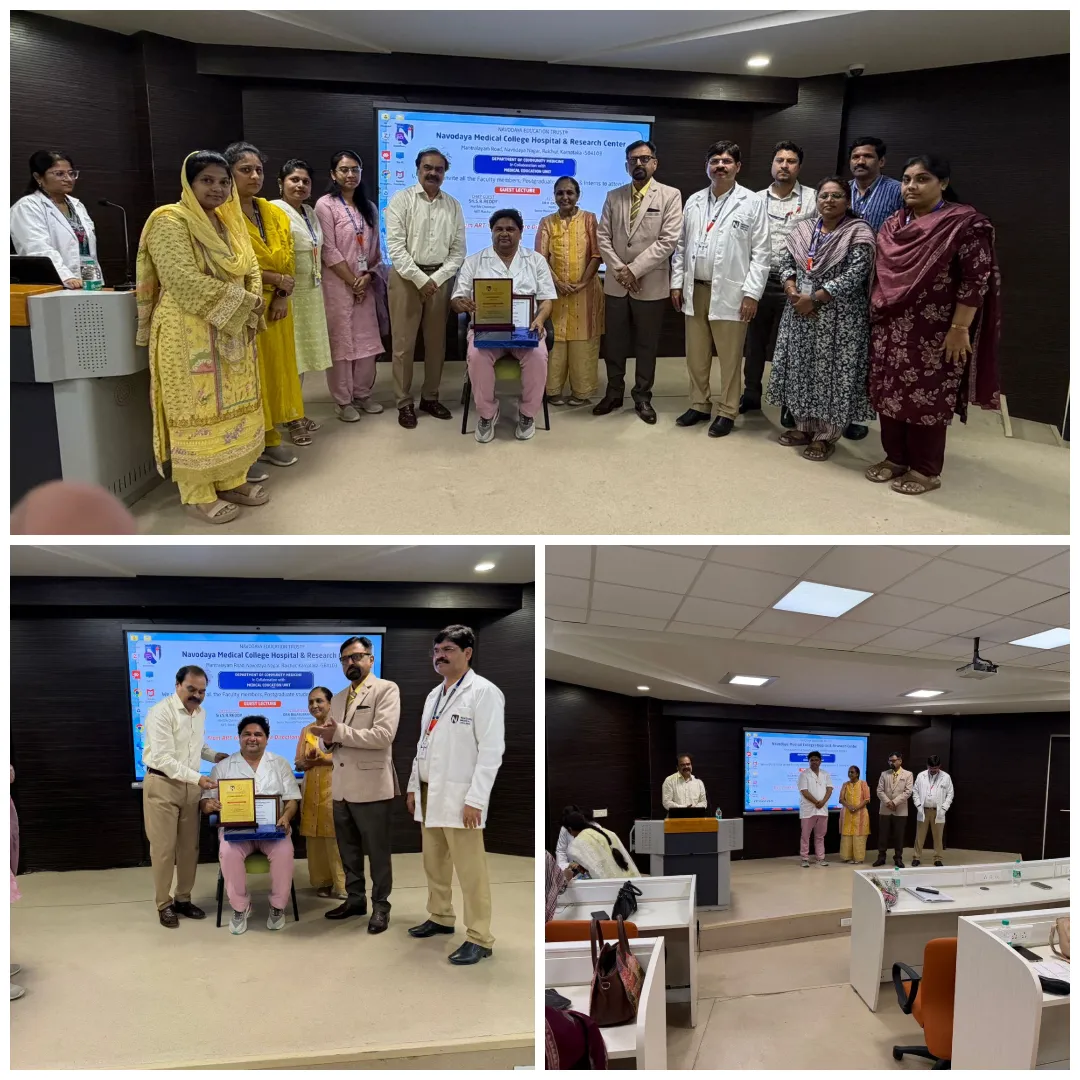

Guest Lecture on “ART to Cure: Future Directions in HIV Research”
The Department of Community Medicine successfully organized an insightful guest lecture on the topic “ART to Cure: Future Directions in HIV Research.” on 26th March 2026. The session aimed to enhance awareness, deepen understanding, and inspire academic interest among students and faculty regarding HIV/AIDS and evolving treatment strategies.
The guest speaker for the lecture Dr Balasubramanya, who is a RIMS ART Nodal Officer from Raichur district, a highly experienced professional in the field of HIV care and management. His extensive field experience and practical insights added immense value to the session.
The guest speaker delivered a comprehensive and engaging talk, beginning with the basic understanding of HIV (Human Immunodeficiency Virus), its structure, and its impact on the immune system—particularly the depletion of CD4+ T cells leading to immunodeficiency.
A detailed explanation of HIV transmission was provided, emphasizing the key routes:
Unprotected sexual contact with an infected individual Blood and blood product transfusion (especially unscreened blood)
Sharing contaminated needles and syringes, particularly among intravenous drug users
Mother-to-child transmission, occurring during pregnancy, childbirth, or breastfeeding
The speaker highlighted that HIV is not transmitted through casual contact, such as hugging, sharing food, or mosquito bites, thereby addressing common myths and misconceptions.
The lecture strongly emphasized the importance of prevention and control strategies, including:
Safe sexual practices, including consistent and correct use of condoms
Screening of blood and blood products before transfusion
Use of sterile needles and syringes in medical and community settings
Prevention of parent-to-child transmission (PPTCT) through antenatal screening and timely ART initiation
Awareness and education programs to reduce stigma and promote early testing
Post-exposure prophylaxis (PEP) and Pre-exposure prophylaxis (PrEP) as important biomedical interventions
The speaker also stressed the importance of early diagnosis and linkage to care, which significantly improves outcomes and reduces transmission.
A major focus of the lecture was on Antiretroviral Therapy (ART), which has transformed HIV from a fatal disease into a manageable chronic condition.
Key points included:
ART suppresses viral replication and improves immune function
Lifelong adherence is crucial for effectiveness
Government programs provide free ART services, ensuring accessibility
The concept of “Undetectable = Untransmittable (U=U)” was explained, highlighting that effective ART can prevent sexual transmission
The speaker elaborated on exciting advancements and future possibilities in HIV research, including:
HIV cure strategies:
Functional cure (long-term control without therapy)
Sterilizing cure (complete elimination of the virus)
Gene editing technologies such as CRISPR for targeting viral reservoirs
Therapeutic vaccines aimed at boosting immune response against HIV
Long-acting injectable ART, reducing the burden of daily medication
Broadly neutralizing antibodies (bNAbs) as potential treatment and prevention tools
Research into latent reservoirs, which remain a major barrier to cure.
The speaker encouraged future researchers to explore opportunities in virology, immunology, epidemiology, and public health, emphasizing the need for interdisciplinary collaboration.
The program was presided over by the esteemed Principal,Dr Gurudatta Pawar whose presence underscored the institutional commitment to public health education and research. Dr Boramma G organizing chairman and HOD of Community Medicine, played a pivotal role in coordinating the session and ensuring its academic rigor.
This was followed by registrar Dr T Srinivas said who shared his insights and experiences on changing trends in HIV diagnosis and treatment and appreciated speaker for sharing such valuable intuition and practical guidance to the young faculties.
The session was highly appreciated for its clarity, depth, and practical relevance. The guest speaker’s thoughtful explanation, use of real-life examples, and ability to simplify complex concepts made the lecture both engaging and informative. His dedication to HIV care and research was evident, inspiring students to consider careers and research in this vital field.
The guest lecture concluded with an interactive session, where students actively participated by asking questions related to HIV management, stigma, and research opportunities. The program successfully enhanced awareness and provided valuable insights into the current and future landscape of HIV prevention and treatment.
📸 Photo Highlights & Further Reading
View the photo highlights of the Guest Lecture on “ART to Cure: Future Directions in HIV Research (2026)” organized by the Department of Community Medicine on our official Instagram page, showcasing key moments from the insightful session led by Dr. Balasubramanya, RIMS ART Nodal Officer, Raichur.
The lecture featured in-depth discussions on HIV awareness, prevention strategies, Antiretroviral Therapy (ART), and emerging research directions aimed at finding a potential cure.
For more updates on guest lectures, health awareness programs, academic activities, and student engagement initiatives, visit the News & Events section of our website.