

CRIME SCENE INVESTIGATION ENACTMENT
Organized by Department of Forensic Medicine and Toxicology Navodaya Medical College Hospital & Research Centre
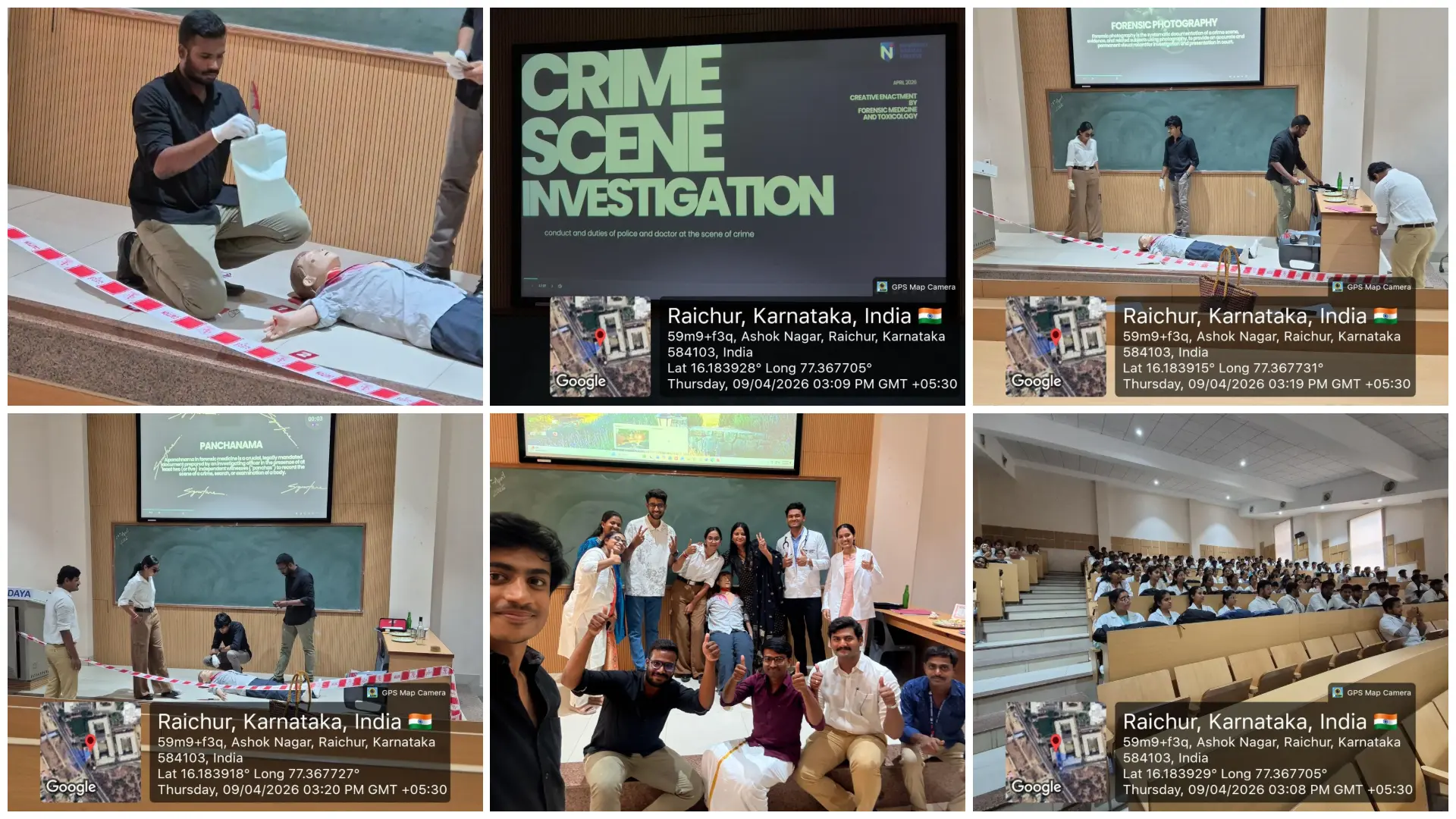
The Crime Scene Investigation Enactment was conducted on 9th April 2026 from 3 PM to 5 PM at Lecture Hall 1 under the guidance of Dr M Mounika Ragini, Assistant Professor.
A realistic and meticulously planned crime scene enactment was conducted by 3rd MBBS students as part of their practical learning in forensic medicine.
The objective of this activity was to provide hands-on exposure to crime scene investigation, evidence recognition, and medico-legal interpretation.
The scene depicted a simulated homicide scenario. A life-sized mannequin was positioned supine on the floor, representing the victim. Artificial blood stains were strategically placed around the neck region, suggesting a possible fatal injury such as sharp force trauma or cut-throat injury. The positioning of the body, with outstretched limbs and visible staining, was carefully designed to mimic a real-life situation.
The students paid close attention to forensic detailing:
- Evidence markers were systematically placed near key findings, including blood stains, potential weapon location, and trace evidence.
- A boundary was created using caution tape to preserve the integrity of the scene, reflecting standard crime scene protocol.
- Blood spatter patterns were demonstrated to help understand directionality and mechanism of injury.
- The surrounding environment was kept controlled to emphasize scene preservation and contamination prevention.
The enactment also incorporated key principles of forensic investigation:
- Securing and isolating the crime scene
- Systematic documentation through observation
- Identification and interpretation of physical evidence
- Correlation of findings with possible cause and manner of death
Students actively participated in analyzing the scene, discussing possible sequences of events, and applying theoretical knowledge to practical observation. The exercise encouraged critical thinking, teamwork, and medico-legal reasoning.
Overall, the activity served as an effective bridge between classroom teaching and real-world forensic application. It enhanced students’ understanding of crime scene management and prepared them for future responsibilities in handling medico-legal cases with accuracy and professionalism.